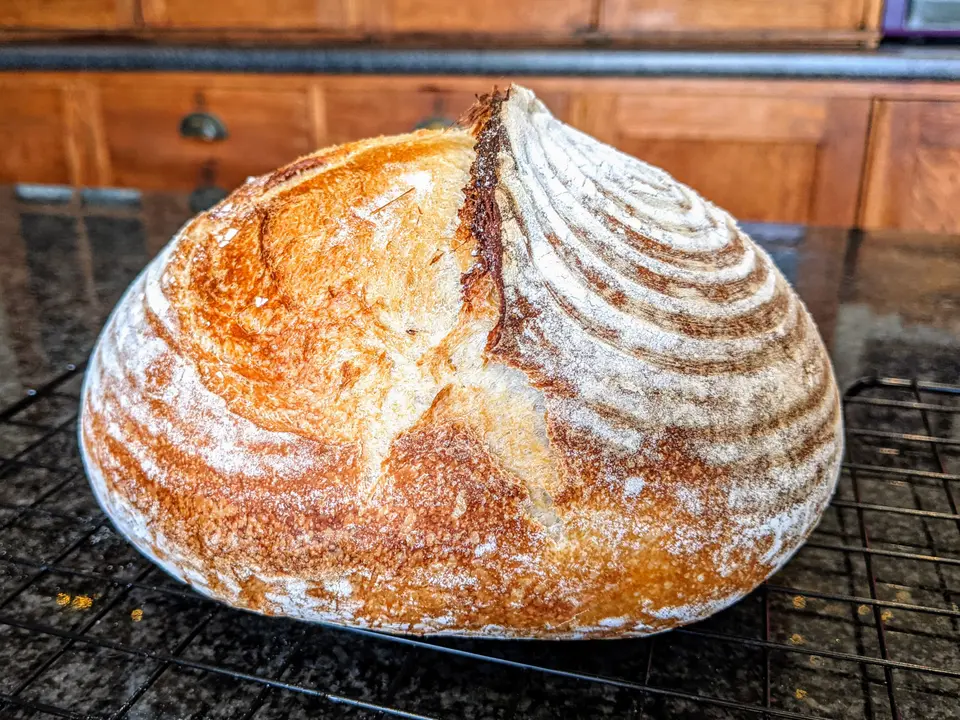
Sourdough bread
My basic sourdough bread recipe
YIELDS
1 loaves
PREP TIME
36 hours
COOK TIME
40 minutes
Ingredients -
bread
50g
extra water
100g
levain
20g
salt
330g
water
400g
white bread flour
100g
wholemeal bread flour
levain
50g
rye flour
20g
sourdough starter
50g
water
Adjust number of loaves:
Method -
Make the levain the night before you want to make the bread. Combine the flour, water and sour dough starter in a clear container and keep on the counter overnight. The levain is ready when it has doubled in size or when a small amount will float in water.
To start making the bread combine the flours and water in a large bowl, reserving the extra water for later. Just mix until all the flour is hyrdrated, then cover with a towel and leave for at least 1 hour. This is the
autolyse step.Once the autolyse is complete, add the levain to the top of the flour and combine using the Rubaud knead. Leave the dough for 15 minutes to let fermentation start and for the dough to relax a bit.
Dissolve the salt in the extra water, then add this to the dough and combine using the Rubaud knead. Leave the dough to relax for 5 minutes.
Turn the dough out on to a counter and form a smooth dough by slap and folding for 2-5 minutes. Stop if you see any tears happening. Return the dough to the bowl, cover with a towel and leave to rest. This is the start of the
bulk rise step.During the first 2 hours of the bulk rise, stretch and fold the dough every 20 minutes or so. No folds are needed after 2 hours, just leave the dough until it has increased in size by about 20-30% and you can begin to see some air pockets appearing on the surface. The bulk rise should take between 3-4 hours in total in a 19-22°C environment.
After the bulk rise has completed, turn the dough onto the counter and leave for 2 minutes before giving it a
preshapeand then resting for 10 minutes.Apply some flour and give the dough a
final shapingbefore dusting with rice flour and placing in the banneton, covering with a towel and leaving in the fridge overnight for thefinal proof.The next morning pre-heat a dutch oven or combi cooker in the oven at 230°C.
Remove the combi cooker from the oven, turn the loaf from the banneton onto base of the combi cooker and dust with some more rice flour.
Using a razor blade, score the length of the dough 2cm from the middle. Make sure to cut at a 90° angle and only about 0.5cm deep (go deeper if using a lower hydration dough).
Give the inside of the combi cooker a few mists of water and then cover the lid over the base.
Cook in the oven for 20 minutes, remove the lid and then cook for a further minutes or until the crust is the desired colour.
Notes -
Use bread flour with at least 13% protein content.
Try to maintain the dough at 20-25°C during bulk rise. If you can use a proofing box, or as a cheaper alternative you can improvise with a heat mat.
I’ve found that you can get away with less kneading / not much at all, as long as you get enough stretch and folds in.
If the starter isn’t particularly active, try making it a bit thicker for a few days (less water / more flour), this will prioritise the yeast growth over the bacteria (reference needed…). This may also reduce the sour-ness of the bread if you find it is a little too sour.